
How It Be
We're all just swimming in the same damn sea

I’m Ben. This band called mothershout is all me. I write, arrange, perform and record the songs, and then I write Substack posts about them, because I enjoy it.
None of the music I release has been composed, arranged or generated by AI. It’s all done by one human of limited skill and questionable artistic judgement.
Grow Up To Be Cowboys was released on July 11th; since then a whole Northern-hemisphere summer has come and gone, and the weather in Vancouver has returned to its natural state of grey skies and rain. A season to spend time indoors, writing songs. This one is called How It Be.
It’s also on Spotify, and if you don’t want to support Spotify, it’s free to listen to on Bandcamp.
The Story
I don’t usually come up with song ideas while I sleep (or maybe I do, but I forget them all as soon as I wake up). But the inspiration for How It Be came when I woke from a dream of a drowning man, being refused rescue because he didn’t look like the right kind of person to be saved. I wrote it down in an email to myself and went back to sleep.
I had been messing around with electric piano sounds, and playing a little chord progression that started on Bm and ended up on B major. I started thinking about turning that dream idea into words and within an hour or so I had the first verse.
I really enjoyed putting this track together, and a lot of that was because I decided I had No Deadline. One downside of writing articles on Substack is that there’s a whole subculture dedicated to maximizing subscribers, emphasizing hustle and consistent posting, and it’s easy to get caught up in and assume that’s the point. I realized I was becoming over-influenced by that, so I discarded the idea of delivering a finished song by any particular date, and just settled back to enjoy arranging and producing it. That’s my excuse for why I haven’t posted for a while.
(I could write something pretentious like craft takes time, but it’s more about me enjoying the journey).
So, let’s dig into the song. Starting with the words.
The Words
I was a sailor, I was lost at sea
And I called out for someone to rescue me
When I saw a light through the waves and the storm
I saw a ship, with a flag flying high
I saw the captain, but he would not meet my eye
He said “I see you drowning, but this is how it be
I’m only gonna save you if you look like me.
We disinclined to seek your company”
I was broken, I had nobody
I was further down than anyone should ever be
When I heard a voice through the rain and the storm
I saw the preacher with his book held high
I stood before him, he said “I think I wanna testify…
Yeah I see you suffering, but this is how it be
You only get to heaven if you think like me
And I don’t subscribe to your philosophy”
Born into the world, we’re all alone
Gotta find the people you can call your own
And if I see you falling, this is how it be
I’m gonna catch you if you call to me
We’re all just swimming in the same damn sea
I don’t think the words need much explanation. They seem pretty clear to me.
But then again, writing words is one of the sticky parts of songwriting, and by sticky I mean it’s about as free and easy as walking on flypaper. You find a great line, but then you’re stuck until you find another to rhyme with it. You scroll through rhyming dictionaries hoping that some word or other will spark joy (they don’t). You finally find a second line but its not singable or it won’t scan right or… it means rewriting the first line.
When it works, though, it’s very satisfying.
With this song, I managed to beat the first verse into shape, and then I took a shortcut by re-writing it to create the second verse. For example, from I saw a ship with a flag flying high to I saw the preacher with his book held high, and rhyming the third lines in each verse with each other. The third verse was the toughest, because everything I wrote seemed too preachy, too why-cant-we-all-just-get-along. It needed to be more resigned, more weary.
In the end, the words work for me; they’re not too obvious, not too direct, and I got to use philosophy again.
The Music
The Piano
Gravity and Hold Me are examples of guitar songs, written on guitars, driven by guitars. To mix things up I wrote How It Be on an (virtual) Fender Rhodes electric piano, by singing the words along as I played around with the chords. I think the song shows traces of its birth; the patterns in which the chords fall match the way the voice sings the lines. The piano influenced the vocals which affected the piano part which changed the vocals and so on.
Then I put the delay (echo) on the piano and ohhh yeah. The song found its sound.
This is the basic piano (from the start of the first verse) without it. It’s played along to a click so that you, listening, and me, the player, can hear the beat.
But with a quarter-note delay, it’s a whole other thing. The piano is on the right, the delay is on the left, and has reverb added so that it swells and blooms.
I put together a really, really simple drum beat, just a kick and a snare, and played the whole song on the piano, over and again, through a whole week until I knew how it should sound. Then I recorded it, and that’s what you can hear on the finished track.
The Rhythm
Once I had the piano down, I had a scaffolding, a framework, a structure I could build on. The next step was to add the rhythm section; the drums and the bass guitar.
Both are played pretty “straight” for much of the song. The drums play a 4/4 pattern with a backbeat, the bass plays mostly steady 1/8 notes. They’re holding down the beat so that the other parts, including the piano, get to play around it.
There’s an exception in the “chorus” (that’s in quotes because it’s not really a chorus in the usual sense), where the rhythm section follows the piano through a set of descending offbeat chords… and then goes back to that steady beat.
The Rest
The guitar (on the left) is the jester with a split personality. In the intro, second verse and the solo it’s playing offbeat single notes through a wah pedal in a kinda funk style. Then in the choruses it suddenly gets all impolite and crunchy to add more bite to the descending chords.
The rest of the arrangement started working because I stopped trying to be harmonically clever.
I really love harmony. Give me a chordal instrument and I’m happy. Let me stack notes on top of each other and I’ll do it all day with a smile. But that’s not aways a good idea, and with this song I gave myself a rule: playing chords is the piano’s job, and the piano has a bad temper and a bad attitude. The rest of the band should stay out of its way. Or if they do play chords, they should respectfully follow the piano’s lead. Don’t mess with the keys.
So the organ plays two-note chords and stays off the piano’s lawn (it’s playing an octave above, and isn’t trying to be rhythmic). The guitar’s all single notes until the chorus, when it follows whatever the piano does. And the brass section (trumpet on the left, sax on the right) play single-note lines, no chords at all.
This one weird trick helped keep the arrangement more open and simple, and let the piano be the star.
The Structure
This song doesn’t have a chorus. Each verse is followed by a section I called a “descent”, because it’s based around that descending, offbeat brass riff. The descent plays the same role as a chorus - it’s repeated, has a familiar melody, and feels different to the verses.
But it’s not a chorus you could sing. I liked the idea of a “chorus” that’s more instrumental than words. There are a couple of funk classics that do something close - Earth, Wind And Fire’s September and Kool And The Gang’s Celebration both do something similar. They have words in the choruses, but only to support a melody (in September, what the heck does bah-dee-yah mean). I was listening to a fair amount of 70s funk when I was arranging this song. Not that I personally have any funk. Or groove.
Songs without choruses show up in all sorts of genres, and in the folk tradition they’re often narratives, that repeat the same structure over and again because they’re about the story more than the music. Paul Simon’s Duncan, for example. Or most early Dylan. How It Be only has two verses, but they tell a story; the singer’s rejected by the Captain and the Preacher for not looking or thinking like them, but doesn’t want to do the same to others (because we’re all swimming in the same damn sea).
The Arrangement
That piano delay got me thinking about offbeats.
Here’s the drums at the start of the first “descent”. The beat’s pretty straight, with a cowbell keeping strict time. But listen to the kick drum - it plays a lot of offbeats.
The piano delay fits in with the drums. You can hear how the sound bounces from right to left so that the delayed piano chords come between the drum hits.
And if the rest of the band joins in, you should hear the same effect. The song shifts from hitting on the beat to punching on the offbeat, and the delayed piano chords fit in between.
If I take the sax out of the solo section, you can hear the band bouncing from left to right and back, alternating between the piano and the guitar.
It bounces, it skips, it jumps around like a toddler on caffeine.
The Artwork
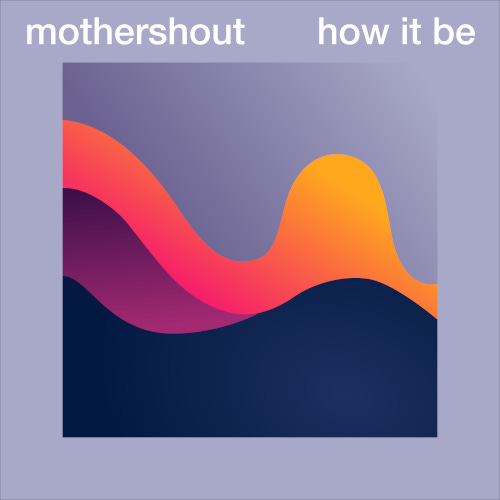
For artwork since Pour Me Another One back in late 2023, I’ve tried to find an image that matches something about a song, and fit that into a simple template. But man, it’s getting hard to find the right picture. That might be just me, of course, but for this song I spent a week searching and coming up with nothing.
So I changed direction. As well as photographs, Unsplash hosts abstract art created by humans. The main image here is by a Indian guy called Deep. It doesn’t really say anything about the music, and I’m fine with that. Unless you think the song is a purple-gray colour with yellow-orange highlights.
The Details
This is the part of the post where I start getting into the weeds about music theory and recording and all that stuff. It may get geeky.
But before that… this is my upgraded and updated little studio where How It Be was written, recorded and mixed.
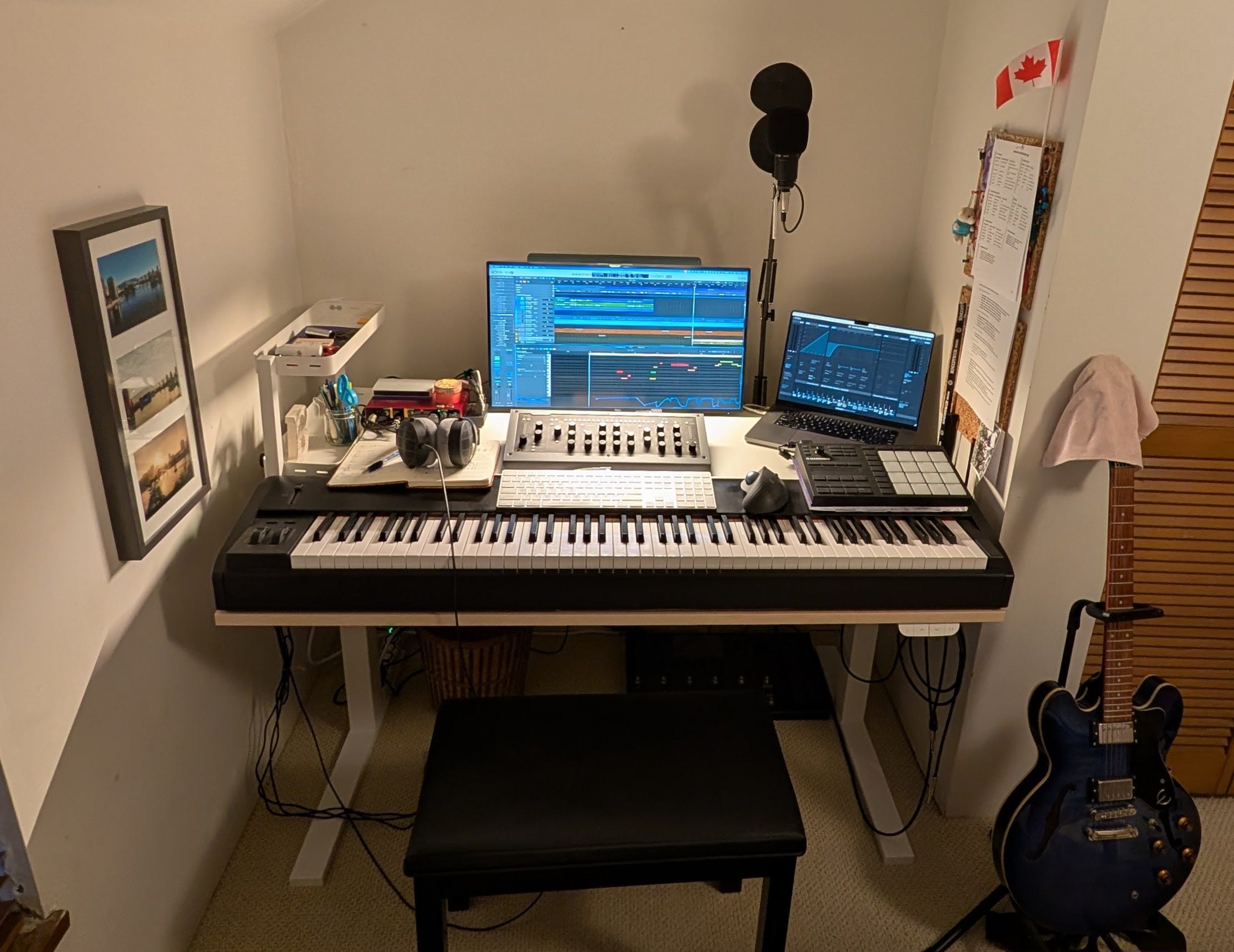
Is that a fancy studio-quality desk? No, it’s an Ikea standing desk, with a piece of white fibreboard on top so that everything sits at the right level above the main keyboard. It’s so much better to work at than my old setup because I don’t get backache any more. I am a convert to the religion of ergonomical workstations.
The Music Theory Bit
This song is mostly in a minor key, but sometimes switches to a mixolydian (major) scale with the same tonic. The original idea was to mess around with the whole blues principle of an ambiguous third; the verse and descent/chorus progressions both start with a chord from the minor key and end on the major tonic chord. The solo backing switches between major and minor IV chords.
(It was originally in B minor, I recorded the piano and bass in B minor, and then I recorded a guide vocal and realized that I’d picked too low a key. So I cursed, had a coffee break and redid the whole thing up a step in C#m).
Here’s the piano at the start of the first verse. The chords are C#m7, B/C#, B/C#. F#/C#, F#m/C# and ending on C# (major).
C#m7 and B are from the key of C# minor. F# could be from either C# minor or major (probably easiest to just call it a potentially borrowed chord). F#m could be from C# minor, or it could be a “heartbreak chord” minor IV in C# major. So it’s all nicely ambiguous.
There are a couple of other interestingly nerdy music details.
First, the V chord (G#) never appears anywhere in this song. There are no V-I transitions. The IV (or IVm) chord is what generally leads back to the tonic. That’s technically called a plagal cadence; the “A-men” at the end of much Western sacred music. Here' I’m using it because I want to keep the harmony a bit more ambiguous, and a V-I movement would be a bit too obvious.
Secondly, the IV and I chords are often voiced in fourths, so F# becomes F#7sus4, voiced as F# B E and C#m (or C# major) becomes C#7sus4 voiced as C# F# B. These aren’t really quartal chords, they’re just good old functional tertian chords with interesting voicings, but they have a nice kind of floaty half-tension to them. You can hear the IV in the 2-bar sections at the end of the descent before the solo, and just before the final three-note riff at the end of the song.
The Instruments
A couple of the cast of music characters are the same ones I’ve been using for the past year or so; Epiphone Dot guitar (in the picture above), a Squier Mini-P bass. The Rhodes piano is courtesy of Modartt’s Pianoteq 8. The drums are the Maple set from Logic Pro’s built-in drum kits.
The brass section is something I’ve used before, on One Day. It’s EastWest’s Hollywood Pop Brass, all shouty and blatant and glorious. This is not the brass sound you’d use for a meditative, soulful song. It punches. It is assertive.
But the best new toy is the saxophone that plays the solo. It’s the SWAM Tenor Saxophone by Audio Modeling, an Italian company who make modelled (as opposed to sampled) instruments of all types. It’s as difficult to play as it is wonderful, and it’s bloody wonderful to play.
It’s so damn controllable. Obviously, you play the notes on a keyboard. That’s the easy bit. You control the level (i.e. how hard the sax player is blowing) with the expression controller (I have this on a pedal under my left foot). You control the vibrato with the modulation wheel (under my left hand). But you can also control growl, flutter, formats, attack… too many things to adjust while you play, even if I had enough pedals and controls for them all.
So I didn’t even try and do it all. I played the solo with expression and vibrato in real time, and then went back and recorded or programmed changes to everything else. So the solo is maybe 50% played and 50% programmed? Either way, this saxophone is a seriously good instrument, and it’s going to show up on more tracks in the future.
The lead vocal is me. The backing vocals are Synthesizer V, generated from the first guide vocal that I did; that’s why they’re (intentionally) not quite in time with the lead vocal. As are the half-spoken/half-sung vocals in the second verse.
The Mix
And finally… everything was recorded and mixed in Logic Pro, using Softube’s Console 1 mixing system running an SSL 4000 E channel strip. I also used Softube’s Tape plugin on buses, and Waves’ J37 tape emulation for delays (I really like tape delays). The mix bus has a Pultec EQ on for a low-end boost and an SSL G-Bus compressor for that good ol’ glue. There’s a limiter at the end of the chain. That’s it.
Cool...I like the Fender Rhodes-ish key sound. Lyricly interesting and nice flow. Has a bit of a 70's vibe to me, which is solid in that this piece is musical as opposed to contrived. Well done.
Good stuff. Ambiguous thirds are the best.
Also, ‘Ambiguous Third’ would make a great band name.